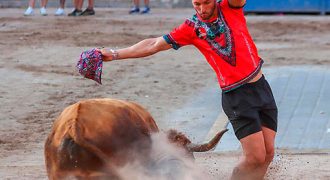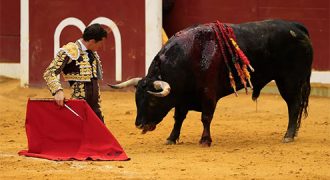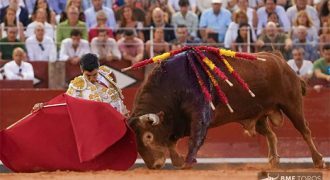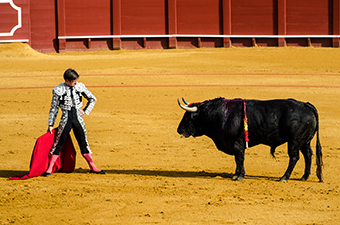
Rarely can a simple, seemingly straightforward English word have created so much confusion and sheer misunderstanding of the activity it is intended to describe. Even taken on its own terms it is misleading. A “fight” surely involves some contact between its contestants, yet apart from the placing of banderillas (usually executed by the matador’s cuadrilla) and the denouement of the kill, the aim throughout is that man and beast should not meet — cape and muleta are not meant to even brush the bull’s muzzle. Working as close to the horns as you can get without being touched by them is the object of the exercise.
 Bill Cranfield
But in a broader semantic context, the word “fight” conveys a totally erronious impression. This is not a contest, with a winner and a loser. Yes, the man might get killed (though rarely, now that penicillin has rendered gangrene an unlikely cause of death) and the bull might survive (considerably more often). But there is no “fighting” involved. So how on earth did “bullfighting” come to serve as the English translation for what Spanish speakers call “toreo”? Well, partly because “toreo” is effectively untranslatable (it would come out as something like “bulling”). And partly because, once upon a time, the “corrida de toros” (literally, running of the bulls) was a kind of combat, or at the very least an engagement with the instincts of self-preservation in the interests of producing danger-defying showmanship.
When bulls were fierce and unruly, it was considered a challenge, a test of skill and courage, manhood even, to confront one and, with the help of mounted picadors and assistants who ran in and stuck banderillas in the hump of muscle on its back (the “morillo”) to weaken the animal’s ability to hold his head high, to temper its instincts to charge at anything that moves by deflecting these charges with a cape or “muleta” prior to killing it with a sword.
It must have been quite a barbaric spectacle and if I had witnessed one, I like to think that I would have sided with the abolitionists. It was a hangover from the medieval “entertainments” of bear-baiting and cock-fighting, if not from the Roman gladiatorial circuses. And for all the morbid fascination it surely provoked, not something — enlightened as we are nowadays about animal rights and the inadmissibility of taking pleasure in cruelty — to be encouraged, not least because of the detrimental effect it probably had on the sensibilities of the spectators, inuring them to the sight of a ring littered with dead horses, their entrails spilling out onto the sand, and a bull often goaded by “exploding” banderillas and other such indignities.
But all that was more than a century ago. Since then, the “peto” has been introduced to protect the horses from horn wounds, “banderillas de fuego” have been banned and the bulls have been bred to be a great deal more manageable. But most important of all, a short, bandy-legged, hunch-backed kid from Seville’s gypsy district of Triana — whom the hyperbolic Hemingway was to describe as one of only two geniuses he had ever met (the other being Einstein) — changed the entire course of what happens in a bullring.
Afflicted by rickets as a malnourished child, he was unsteady on his feet and unable to run fast. But he had a burning ambition to become a torero. Legend has it that with his gang of fellow street urchins, he would swim the Guadalquivir river on moonlit nights and “torea” the bulls grazing in nearby ranches with his shirt (a heinous crime, because it takes a bull about 10 minutes to realise that the lure it is being presented with is just that — and that its quarry should be the man holding it; and this is a lesson it will carry with it into the ring when it finally appears in one).